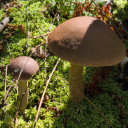
Melanoleuca sp. (cf urticocystis grp.)

Es gibt 11 Antworten in diesem Thema, welches 1.372 mal aufgerufen wurde. Der letzte Beitrag () ist von Clavaria.

  • Dear friends, long time no see.


    From Malta (Gozo) I encountered this grey mushroom growing in small clumps in a garden-soil in a park under Cypress trees. It is a Clitocybe (Funnel fungus) with a faint sweet-fruity scent, taste mild-mushroom at first than changes to sharp, bitter-acid....


    In the lab:

    Spore print pure white


    Spore Size

    (5.8) 6.4 - 7.3 (7.6) × (4.4) 4.6 - 5.3 (5.5) µm

    Q = 1.3 - 1.5 ; N = 29

    Me = 6.8 × 4.9 µm; Qe = 1.4


    Spore shape: pip-shaped (like orange seeds) with what looks to be a warty surface.


    I had high hopes of Clitocybe nebularis but two things are a bit off:

    1. Spore width a bit too high (Q is higher for nebularis?)

    2. Spores seems warty but nebularis have them smooth.


    * Maybe I am sleepy right now, but spore shape is not Entolma-ish right?

    .... well, Entolmas has pinkish spore prints, so cant be E.


    Otherwise it is a good match.
  • Hi Steve,


    if it's not a Melanoleuca, it could also be a Leucopaxillus, which also may have ornamented, amyloid spores and also may have cheilocystidia (but different shape than in Melanoleuca). Unfortunately, the pictures don't show the type of lamella attachment. A white stem is not very common in Melanoleuca.


    The Leucopaxillus species are mostly very rare, they might be in special literature only.


    Wolfgang

  • Dear friends - thank you for helping out. I will do further tests as you kindly suggested and report back. I agree the spores are not of Clitocybe now despite the close resemblance to a C. nebularis - (I thought there are some exceptions). So good to learn this genus is always smooth-spored .


    This photo somehow reveals a sinusoidal lamellar attachment (look at the right):


  • Hi Steve,

    so it's definitely a typical Melanoleuca Subgen. Urocystis, with septate and crystal-headed cheilocystidia.


    The Chloralhydrate in Melzer kills the cell, which easier allows the Iodine to pass through the cell walls. It also increases transparency of the cell content, which makes it easier to observe the stain.


    Wolfgang

  • Steve_mt

    Hat den Titel des Themas von „Clitocybe nebularis ?“ zu „Melanoleuca sp. (cf urticocystis grp.)“ geändert.
  • I will be in part repeat what I have written in another related post on a Melanoleuca finding.


    After a quick check of the keys by Antonin et al. (2017) and learning about the complexity of this genus, I decided to sequence my finding later this month. As mentioned above, it is more worth sequence it for some 30-40Eur and have a >90% confident result, rather spend 8-10 hours of reading and analysing dissections which will still leave you in a sea of uncertainty.


    Well with the keys of Antonin et al. (2017) I have easily determined my specimen as M. excissa for its white stipe and context, greyish light brown cap and matching habitat, habit (short stipe) and almost-matching spore dimensions (my specimen slightly shorter at 7 x 5um mean). Interesting was the slightly but well detectable sweet-fungoid scent.


    Yet the key of this paper lack several cryptic species, hence sequencing is the definite way to be more sure .

  • Dear friends,


    I finally got the molecular sequencing results using ITS1b marker

    Melanoleuca castaneofusca OQ586675 99.85%

    Melanoleuca melaleuca MH856170 99.1%


    I do not think this is melaleuca so I think we can assign it to M. castaneofusca (Urticocystis group ) , but my issue with this ID is that the cap is not as much dark brown as the species usually is.


    According to a phylogenetic study in 2021, closely related species are:

    • Melanoleuca luteolosperma  
    • Melanoleuca excissa
    • Melanoleuca pseudopaedida
    • Melanoleuca robertiana
    • Melanoleuca microcephala

    if someone is interested in this I can share the AB1 / Fasta sequences.


    Thank you for your help in writing this post. I greatly appreciate it


    Ref:

    J. Fungi 2021 , 7 (3), 191; https://doi.org/10.3390/jof7030191

    Melanoleuca galbuserae , M. fontenlae and M. acystidiata —Three New Species in Subgenus Urticocystis ( Pluteaceae , Basidiomycota) with Comments on M. castaneofusca and Related Species


    LG

    Steve